Quarterly Estimated Taxes for the Self-Employed: 2026 Dates and a Worked Example
Looking for a tool?
The 2026 due dates are 15 April 2026, 15 June 2026, 15 September 2026 and 15 January 2027, and you generally need to pay if you expect to owe $1,000 or more when you file. On $72,000 of freelance profit (single filer, no other income, standard deduction) the full-year bill works out at $16,064.22 — $4,016.05 a quarter, or 22.3% of profit. That is well under the 30% set-aside rule everyone repeats, and the whole calculation is below so you can check it against your own numbers. This is an organisational guide, not tax advice — your bracket, state, filing status and deductions all move the answer, and a tax professional is the person to confirm it.
The four 2026 dates, and the uneven quarters nobody warns you about
These come straight from the IRS's own Form 1040-ES (2026), read 9 September 2026.
| Payment | Covers income earned | 2026 due date | Months covered |
|---|---|---|---|
| 1st | 1 Jan – 31 Mar | 15 April 2026 | 3 |
| 2nd | 1 Apr – 31 May | 15 June 2026 | 2 |
| 3rd | 1 Jun – 31 Aug | 15 September 2026 | 3 |
| 4th | 1 Sep – 31 Dec | 15 January 2027 | 4 |
Read the right-hand column again. The second "quarter" is two months and the fourth is four. If you are setting money aside evenly month by month, that is fine — but if you are computing each payment from the income of the period it covers, the June payment covers a short window and the January one covers a long one. Miscounting that is the single most common first-year mistake.
Two dates worth knowing beyond the four. If a due date lands on a Saturday, Sunday or legal holiday, the IRS says the payment "will be on time if you make it on the next day that's not a Saturday, Sunday, or legal holiday." And you can skip the January payment entirely: Form 1040-ES states you do not have to make the payment due 15 January 2027 "if you file your 2026 tax return by February 1, 2027, and pay the entire balance due with your return." That is a real option for anyone who has their books closed early.
Do you actually have to pay quarterly?
The IRS threshold is plain: individuals "generally have to make estimated tax payments if they expect to owe tax of $1,000 or more when their return is filed" (irs.gov). Two things follow that people miss. First, that is $1,000 of tax, not $1,000 of income — and self-employment tax counts toward it, which is why the threshold arrives sooner than most freelancers expect. Second, if you also have a job, extra withholding on the W-4 at that job can cover the freelance income instead; withholding is treated as paid evenly through the year regardless of when it actually happened, which is a genuine advantage over quarterly payments.
The worked example: $72,000 of profit, line by line
This follows the 2026 Form 1040-ES worksheets in order. Single filer, $72,000 net profit on Schedule C line 31, no wages, no other income, standard deduction, and — stated honestly — no qualified business income deduction, which would reduce the answer further. Every rate and threshold is from the form.
Step 1: self-employment tax
- Net profit subject to SE tax: $72,000.00
- Multiply by 92.35% (the form's line 3): 72,000 × 0.9235 = $66,492.00
- Medicare at 2.9%: 66,492 × 0.029 = $1,928.27
- Social Security at 12.4%, up to the 2026 maximum of $184,500: 66,492 × 0.124 = $8,245.01
- Self-employment tax: 1,928.27 + 8,245.01 = $10,173.28
That 92.35% is not a rounding convenience. It exists because an employee's share of payroll tax is calculated after the employer's half is taken out, and the multiplier puts a self-employed person on the same footing. Skipping it overstates the bill by about 7.65%.
Step 2: income tax on what is left
- Deduct half the SE tax: 10,173.28 × 50% = $5,086.64
- Adjusted gross income: 72,000 − 5,086.64 = $66,913.36
- Less the 2026 single standard deduction of $16,100: $50,813.36 taxable
- 2026 Schedule X: $5,800.00 on the first $50,400, then 22% of the $413.36 above it = $5,890.94
Step 3: the number that goes on the voucher
Total 2026 tax = $5,890.94 income tax + $10,173.28 self-employment tax = $16,064.22. Divided four ways, that is $4,016.05 per quarter.
Now the part worth the whole article. $16,064.22 on $72,000 of profit is 22.3%. Set aside the widely repeated 30% and you would park $21,600 — $5,535.78 more than the bill, money sitting idle for a year. Set aside 25% and you are still $1,935.78 over. Over-reserving is far safer than under-reserving, and if you have state income tax the gap closes or disappears, but a percentage you picked off a forum is not a plan. Run your own figures once and use your own number.
The safe harbour: the rule that caps what you have to send
You do not have to predict the year correctly. The IRS penalty is avoided if you "owe less than $1,000 in tax after subtracting their withholdings and credits, or if they paid at least 90% of the tax for the current year, or 100% of the tax shown on the return for the prior year, whichever is smaller." One qualifier matters: substitute 110% for 100% if your prior-year adjusted gross income was more than $150,000 ($75,000 if married filing separately).
Read that as an option, not a hurdle. Say the freelancer above paid $9,800 in tax last year. Paying 100% of that prior-year figure — $2,450 a quarter instead of $4,016.05 — satisfies the safe harbour even though this year's bill is higher. The remaining $6,264.22 is still owed, but it is due with the return rather than in instalments, and no underpayment penalty applies. For a business having an unusually good year, that is real cash-flow room, and it is the strongest argument for basing payments on last year's known number rather than this year's guess.
The mistakes that actually cost money
- Setting aside a percentage of revenue instead of profit. Tax is on profit. On $72,000 of profit from $110,000 of revenue, 25% of revenue is $27,500 against a $16,064.22 bill — you have starved the business of $11,000 of working capital to solve a problem you did not have.
- Forgetting self-employment tax is the bigger half. In the example above, SE tax is $10,173.28 and income tax is $5,890.94. People budget for the income tax they remember from a payslip and are blindsided by the rest.
- Keeping the tax money in the business account. It gets spent. Not deliberately — it simply looks like available balance on the day a supplier invoice lands.
- Not tracking deductions through the year. Every legitimate expense you fail to record inflates profit and therefore inflates all four payments. This is the cheapest tax saving available and it is pure bookkeeping.
- Paying late because the money was there. The penalty is charged per period, so a payment that is right in total but late in Q2 can still attract one.
- Recomputing from scratch every quarter. Income moves. Reconcile against actual year-to-date profit at each deadline and adjust the remaining payments, rather than either sticking to a January guess or starting over four times.
Doing this in a spreadsheet
The mechanics are simple enough that a sheet handles them: a column for the income you have actually received, a running profit figure, your own set-aside percentage applied automatically, and four rows for the payments with their dates. What a sheet gives you that a calculator does not is the year-to-date view at each deadline — the thing you need to answer "am I still on track" rather than "what is one payment".
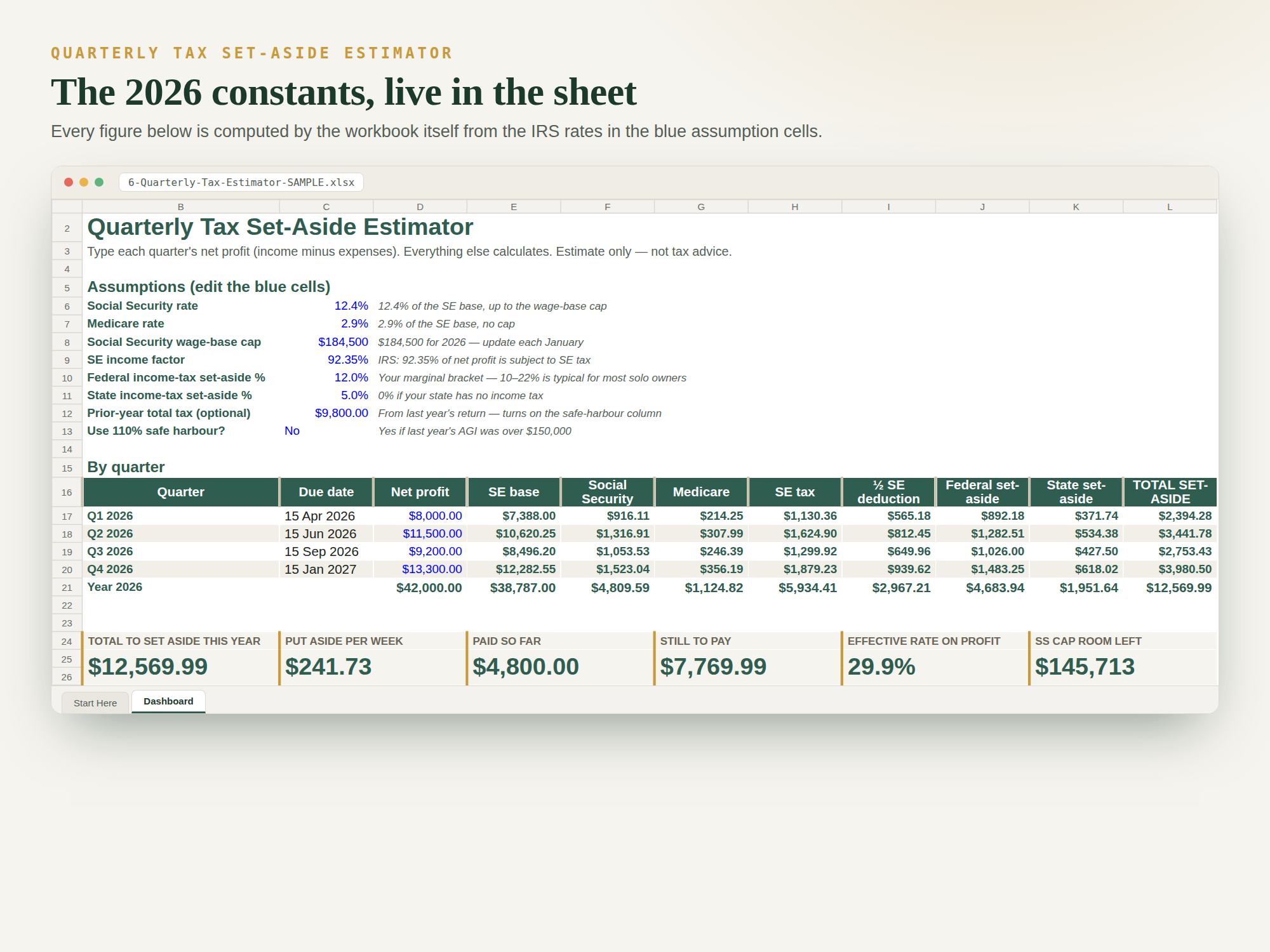
The estimator running its sample year. Note the effective rate reads 29.9% against the 22.3% computed earlier, and the difference is not an error: this sheet adds a 5% state set-aside and applies a flat 12% federal rate rather than the graduated 2026 schedule, on $42,000 of profit rather than $72,000. Two honest methods, two different answers — which is exactly why the number has to be yours rather than a rule of thumb.
Our free self-employed tax calculator runs the SE-tax side of the arithmetic above in the browser with no signup, and the free bookkeeping template gives you the profit figure to feed it. If you want the tracking and the quarterly set-aside in one workbook, that is what the paid version is for.
Quick FAQ
When are quarterly taxes due in 2026?
15 April 2026, 15 June 2026, 15 September 2026 and 15 January 2027, per Form 1040-ES (2026). If a date falls on a weekend or legal holiday it moves to the next business day, and you can skip the January payment if you file your 2026 return by 1 February 2027 and pay the balance with it.
How much should I set aside for quarterly taxes?
Work it out rather than guessing. On $72,000 of profit for a single filer with no other income the answer is 22.3%, not the 30% commonly quoted. Your figure moves with filing status, state tax, other income and deductions, so compute it once from your own numbers and re-check when the year changes shape.
What happens if I underpay or skip a quarter?
The IRS may charge an underpayment penalty, calculated per period rather than on the year as a whole, so a late Q2 can attract one even if the annual total ends up correct. You avoid the penalty entirely if you owe under $1,000 after withholding and credits, or if you meet the safe harbour.
What is the safe harbour rule?
Pay at least 90% of this year's tax or 100% of last year's tax, whichever is smaller, and no underpayment penalty applies. Use 110% of last year's instead of 100% if your prior-year AGI was over $150,000 ($75,000 if married filing separately).
Do I pay quarterly taxes if I also have a job?
Not necessarily. Increasing withholding at the job can cover the freelance income, and withholding counts as paid evenly across the year no matter when it happened — which can be more forgiving than instalments if your freelance income is lumpy.
Is self-employment tax the same as income tax?
No, and both are due. Self-employment tax is 15.3% — 12.4% Social Security up to the 2026 cap of $184,500 plus 2.9% Medicare — charged on 92.35% of net profit. Income tax is then charged separately on your taxable income. In the worked example the SE tax is the larger of the two.
Do I have to file if I made very little?
The IRS requires a return if your net earnings from self-employment were $400 or more, which is a much lower bar than the $1,000 estimated-payment threshold. The two rules are separate and people conflate them.
Sources, all read 9 September 2026: IRS Form 1040-ES (2026) for the due dates, the 92.35% multiplier, the $184,500 Social Security maximum, the $16,100 single standard deduction, the 2026 Schedule X rates and the 1 February filing option; IRS Estimated Taxes for the $1,000 threshold and the safe-harbour wording; IRS Estimated Tax FAQs for the weekend rule and the 110% / $150,000 AGI qualifier; IRS Self-Employment Tax for the 15.3% split and the $400 filing threshold. Figures recomputed by hand. Confirm against the IRS and your own adviser before you file.
Related: how much to set aside for self-employed taxes · the deductions checklist that lowers all four payments · how to track business expenses for taxes · the pillar: running your small-business money in Google Sheets.