Free download · no email · Google Sheets & Excel
Free Small Business Bookkeeping Template: income, expenses, and a dashboard that does the sums
A cash-basis ledger for a sole proprietor or small business: log money in, log money out against the fourteen IRS Schedule C expense lines, and read net profit, margin, month-by-month totals and deductible expenses off a dashboard that calculates itself. No email wall, no watermark, no locked cells.
Download the free template (.xlsx) Read the bookkeeping guide
What is in it
- Income log — date, who paid, description, invoice number, method, amount. One row per payment received. 400 rows.
- Expenses log — date, paid to, description, a category dropdown with the Schedule C Part II lines (advertising, car & truck, contract labor, insurance, legal & professional, office, rent, repairs, supplies, taxes & licenses, travel, meals, utilities, other), method, amount, and a deductible-% column that applies the 50% meals rule for you.
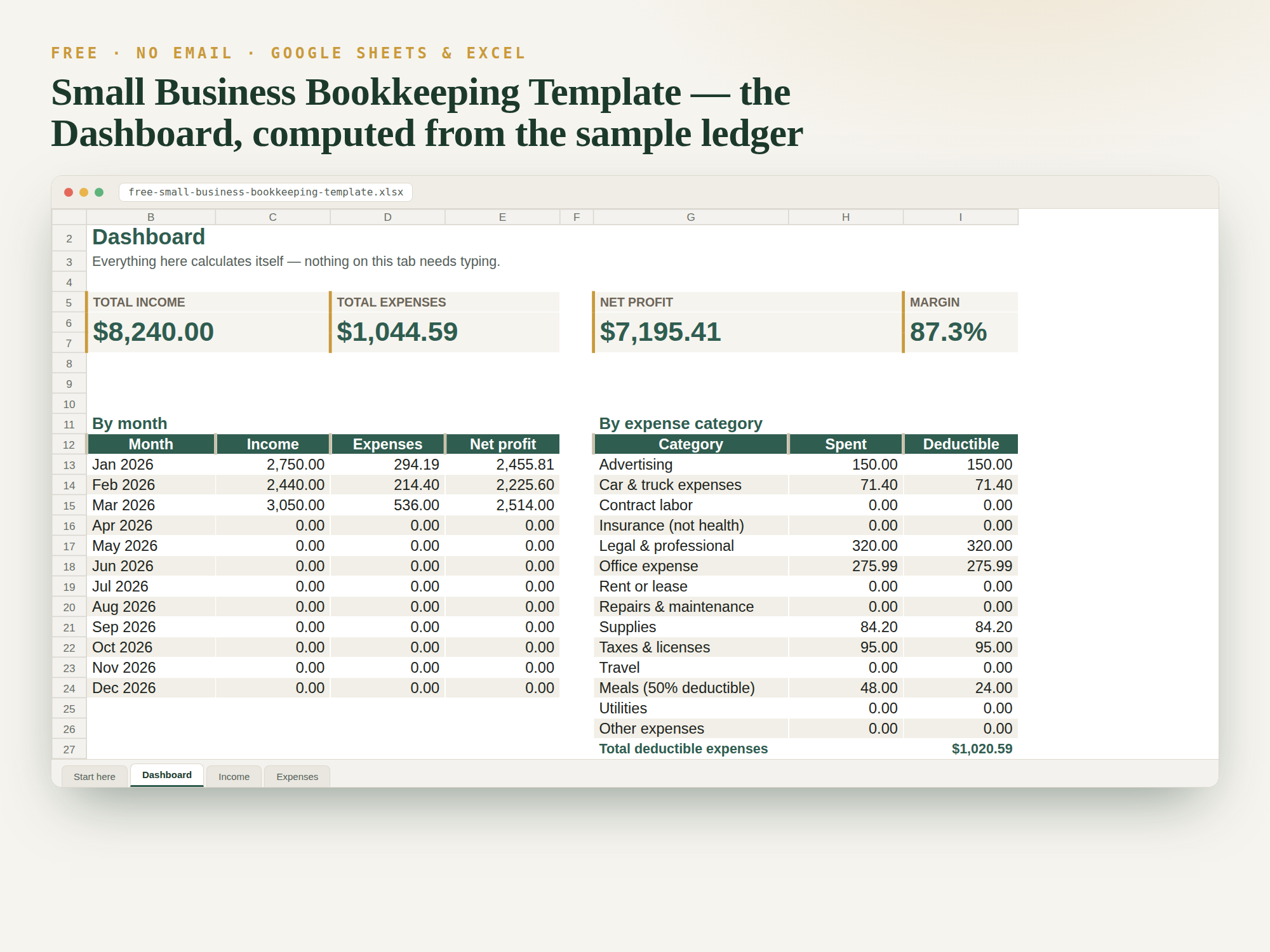
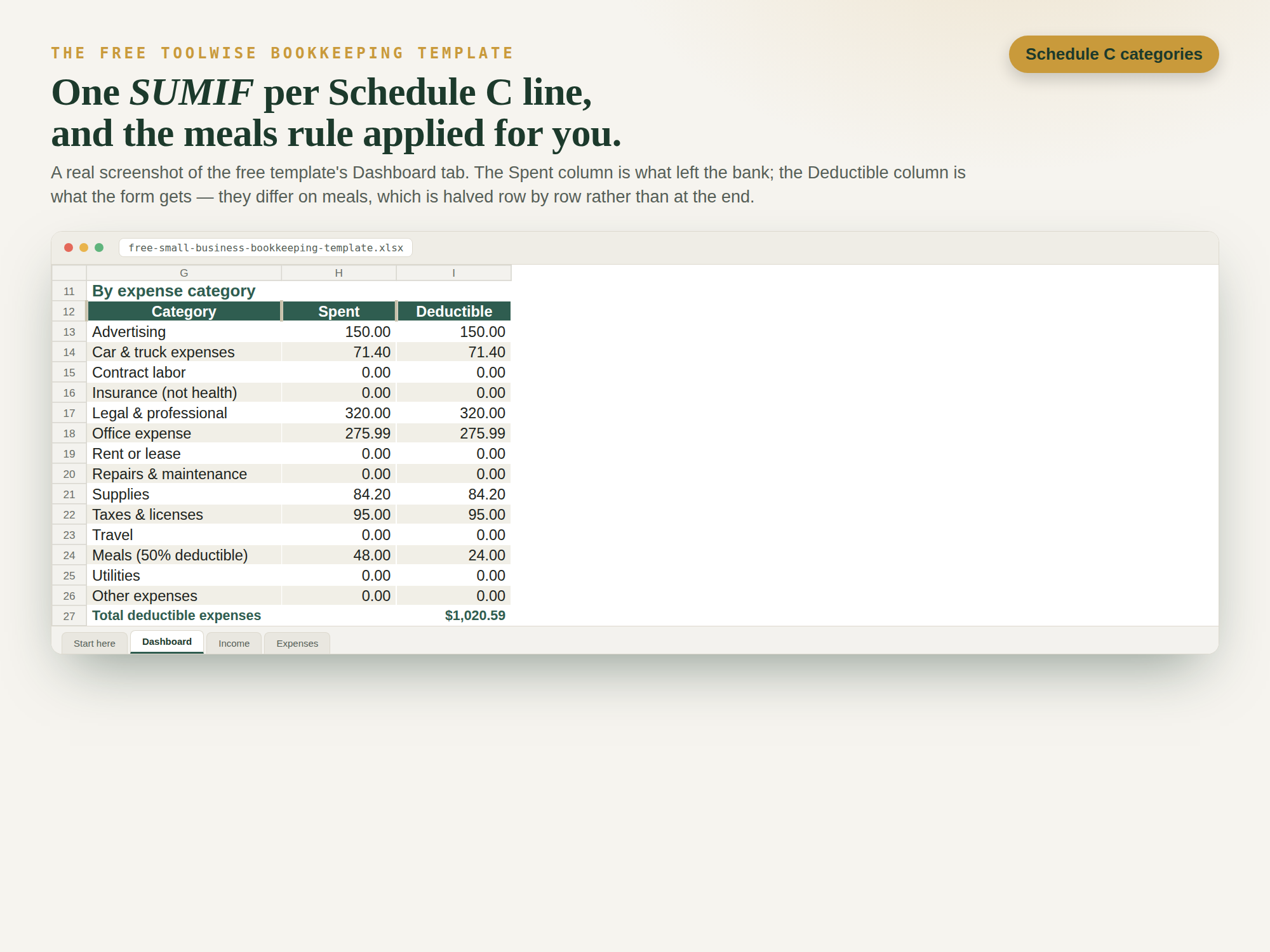
- Dashboard — total income, total expenses, net profit and margin; a twelve-month table of income, expenses and net; and spend plus deductible amount by category, with a total deductible line you can carry to the tax form.
- Start here tab — how to open it in Google Sheets, why cash basis, every formula written out so you can check it, and the category list in case an import drops the dropdown.
How to use it
- Download the file. In Google Sheets choose File, Import, Upload, then Replace spreadsheet. In Excel just open it.
- Delete the sample rows (they are there so the dashboard has something to show) and log your own: income when the money arrives, expenses when you pay. Pick the category from the dropdown rather than typing it, so the category totals stay clean.
- Look at the Dashboard once a month. The month table tells you whether the business made money this month; the category table tells you where it went; the deductible total is the number your tax preparer wants.
A worked example, from the sample rows in the file
The template ships with six income rows and eight expense rows for a small design studio's first quarter. Income is $1,800 + $950 + $1,800 + $640 + $1,800 + $1,250 = $8,240. Expenses are $59.99 + $84.20 + $150 + $71.40 + $48 + $95 + $216 + $320 = $1,044.59. Net profit is therefore $7,195.41 and the margin is $7,195.41 ÷ $8,240 = 87.3% — high, because a solo service business with no stock and no staff genuinely runs that way before the owner's own pay and tax.
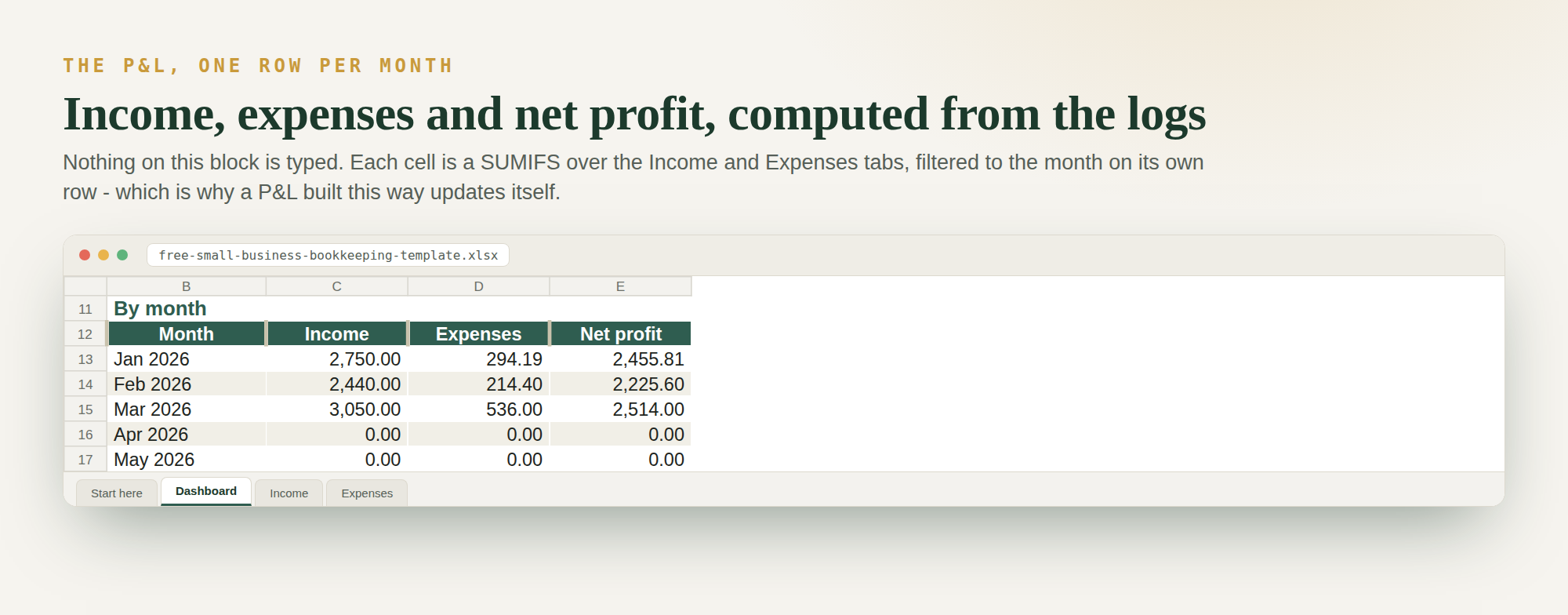
The month table splits it: January $2,750 in against $294.19 out, February $2,440 against $214.40, March $3,050 against $536. The one line that is not simply "spent" is meals: the $48 client lunch is 100% spent but only $24 deductible, so total deductible expenses are $1,044.59 − $24 = $1,020.59, not $1,044.59. That is the difference the deductible column exists to catch, and it is the one most free templates get wrong.
Or keep the books right here, before you download anything
The same ledger, running in your browser. It starts loaded with the file’s own sample quarter, so you can watch the worked example above compute itself — then clear it and log your own. The fourteen categories are the workbook’s own dropdown list, read out of the file rather than retyped, and meals default to 50% deductible exactly as the sheet does. Nothing is uploaded. Entries stay in this browser only, and “Download as CSV” gives you a file that opens straight in Google Sheets or Excel.
Income
| Date | Received from | Amount |
|---|
Expenses
| Date | Paid to | Category | Amount | Ded. % | Deductible |
|---|
By month
| Month | Income | Expenses | Net profit |
|---|
By Schedule C category
| Category | Spent | Deductible |
|---|
Cash basis: log income when the money arrives and expenses when you pay. Not tax advice — the categories follow Schedule C, but your situation is yours.
What it deliberately does not do
No invoicing, no payroll, no inventory, no accrual accounting, no multi-currency, no bank feed. It is a cash-basis income and expense ledger with a live dashboard, which is what most solo businesses actually need for their first years. If you want quarterly tax set-aside estimates, mileage, a receipt link on every expense and a year-end summary laid out for the return, that is the paid Small Business Bookkeeping workbook; if you have employees or stock, you want accounting software rather than a bigger sheet. None of this is tax advice — the categories follow Schedule C, but your situation is yours.
The formulas, so you can check them
- Total income = SUM of the Income amount column; total expenses = SUM of the Expenses amount column; net profit = the difference; margin = net profit ÷ total income.
- Month totals = SUMIFS on the amount column with the date column between the first and last day of the month (EOMONTH does the last day).
- Category totals = SUMIF on the Expenses category column; deductible = amount × deductible %, summed the same way, so the meals rule is applied line by line.
- Ranges are bounded at 400 rows on purpose — whole-column formulas make a file slow to open in Google Sheets. Insert rows above the last row and the ranges stretch with you.
Every one of those formulas is machine-checked against hand-worked figures before the file is published — 28 checks, listed on the file's own Start here tab.
Related free tools
Profit margin calculator · Self-employment tax · Mileage deduction · Break-even units · Free rental property spreadsheet