Small Business Expense Categories, Mapped to Schedule C
Looking for a tool?
There are 20 numbered expense lines on IRS Schedule C, Part II — lines 8 through 27 — which become 24 boxes once you count the a/b sub-lines, plus line 30 for the home office, which the form deliberately keeps out of Part II. Those lines are your expense categories. You do not have to invent a category list: the IRS already published one, your accountant already works from it, and a solo business realistically touches about fourteen of the boxes. Match your spreadsheet to them and tax season stops being a translation exercise. (Line numbers below are read from the 2025 revision of Schedule C (Form 1040) at irs.gov. This is an organisational guide, not tax advice.)
The map: every Schedule C expense line
Labels in the middle column are the form's own wording. The right column is what a small business actually puts there.
| Line | The form's label | What goes here |
|---|---|---|
| 8 | Advertising | Ads, listing and promotion fees, business cards, your website, signage, print |
| 9 | Car and truck expenses | Either business miles at the standard rate or actual vehicle costs by business-use share — see below |
| 10 | Commissions and fees | Referral commissions and sales commissions you pay out |
| 11 | Contract labor | Subcontractors and freelancers you hire (people who are not employees) |
| 12 | Depletion | Natural resources. Almost never used by a service business |
| 13 | Depreciation and section 179 expense deduction | Durable equipment: the van, the mitre saw, the camera, the laptop. Not supplies |
| 14 | Employee benefit programs | Benefits for employees. Empty if you have none |
| 15 | Insurance (other than health) | Liability, professional indemnity, equipment and business vehicle cover |
| 16a | Interest: Mortgage (paid to banks, etc.) | Mortgage interest on business property |
| 16b | Interest: Other | Business loan and business credit card interest |
| 17 | Legal and professional services | Accountant, bookkeeper, solicitor, tax preparation |
| 18 | Office expense | Paper, ink, postage, stationery, small office bits |
| 19 | Pension and profit-sharing plans | Plans for employees — not your own retirement contributions |
| 20a | Rent or lease: Vehicles, machinery, and equipment | A leased van, a hired lift, plant rental |
| 20b | Rent or lease: Other business property | Workshop, unit, studio, storage locker |
| 21 | Repairs and maintenance | Fixing what you already own. A saw service, not a new saw |
| 22 | Supplies | Consumables used up in the work: blades, sandpaper, fixings, packaging |
| 23 | Taxes and licenses | Trade licences, permits, business registration, some local taxes |
| 24a | Travel | Fares, flights, hotels for business trips away from home |
| 24b | Deductible meals | Business meals — subject to the 50% rule, see below |
| 25 | Utilities | Power, water and phone for the business premises or line |
| 26 | Wages (less employment credits) | Employee payroll. Not your own draw |
| 27a | Energy efficient commercial bldgs deduction | Specialist; needs Form 7205 |
| 27b | Other expenses (from line 48) | Anything with no home above: software subscriptions, bank and processing fees, dues, trade publications, training. Itemised in Part V |
| 30 | Expenses for business use of your home | The home office. Sits below the Part II total on purpose |
Two things fall out of that list immediately. First, there is no "software" line — the single biggest recurring cost for most modern one-person businesses lands in line 27b, "Other expenses", which you itemise in Part V. Second, several lines (12, 14, 19, 26, 27a) simply do not apply to a business with no employees, which is why the working list is fourteen rather than twenty-four.
The "ordinary and necessary" test
Before a category question comes a qualifying question. The filter is whether a cost is ordinary — normal for your line of work — and necessary, meaning helpful and appropriate for running it. A plumber's pipe wrench passes without discussion; their weekend fishing trip does not. When something is genuinely mixed, like a phone used for both, you claim the business-use share and write down how you arrived at the percentage. If you cannot explain the expense in one sentence to a stranger, that is your answer.
A worked month, line by line
A solo handyman, March 2026. Nine jobs, $6,480.00 collected. Here is the month's spending sorted onto the form.
| Line | Category | What it was | Amount |
|---|---|---|---|
| 8 | Advertising | Google Ads $180.00, local paper $45.00 | $225.00 |
| 9 | Car and truck | 412 business miles × $0.725 | $298.70 |
| 11 | Contract labor | Helper, two days | $360.00 |
| 15 | Insurance | General liability, monthly | $118.50 |
| 17 | Legal and professional | Bookkeeper | $150.00 |
| 18 | Office expense | Paper and ink | $34.20 |
| 20b | Rent or lease | Storage unit | $95.00 |
| 21 | Repairs and maintenance | Mitre saw service | $87.40 |
| 22 | Supplies | Blades, sandpaper, caulk, fixings | $268.15 |
| 23 | Taxes and licenses | City trade licence renewal | $75.00 |
| 24a | Travel | One night away, out-of-town job | $92.00 |
| 24b | Deductible meals | Client lunch ($46.00 spent) | $46.00 |
| 25 | Utilities | Business phone line | $58.00 |
| 27b | Other expenses | Trade association dues | $40.00 |
Spending totals $1,947.95. But the number that goes to the form is not that: the client lunch is halved, so $46.00 becomes $23.00 and deductible expenses are $1,924.95. Tentative profit — Schedule C line 29, revenue minus the Part II total — is $6,480.00 − $1,924.95 = $4,555.05, a 70.3% margin before the home office, the owner's own pay and tax.
Two purchases that month are deliberately not in the table. A $1,450.00 mitre saw is durable equipment, so it belongs on line 13, not line 22 with the blades. And a 120 sq ft home office under the simplified method is 120 × $5.00 = $600.00 a year, which goes on line 30 below the Part II subtotal. Put either one in the wrong bucket and your monthly expense total swings by more than the month's entire supplies bill.
The $2,500 rule that decides expense vs. asset
The question that sends more small filers wrong than any category choice: you bought a $900 laptop — is that an expense this year, or an asset you depreciate over several years? There is a bright line, and it is an election you make, not a judgement call.
Under the IRS's de minimis safe harbor election, in the agency's own words: “If you have an applicable financial statement (AFS), you may use this safe harbor to deduct amounts paid for tangible property up to $5,000 per invoice or item (as substantiated by invoice). If you don't have an AFS, you may use the safe harbor to deduct amounts up to $2,500 ($500 prior to Jan. 1, 2016) per invoice or item.”
| Your situation | Threshold | Measured |
|---|---|---|
| No applicable financial statement (most sole proprietors) | $2,500 | per invoice or item |
| With an applicable financial statement (audited financials) | $5,000 | per invoice or item |
Source: IRS, Tangible Property Final Regulations, implementing Treas. Reg. § 1.263(a)-1(f) (T.D. 9636). Read 2026-09-09. The election is made annually on a timely-filed return — confirm your own position with a qualified professional.
The practical upshot for a spreadsheet: “per invoice or item” is the phrase that matters. A $900 laptop sits comfortably under $2,500, so with the election it goes straight into an expense category rather than a depreciation schedule. Three $900 laptops on one invoice are still measured per item. This is also why the Receipt link column earns its keep — the threshold is substantiated by invoice, so the invoice is the evidence, not your memory of the price.
The four categories people file wrong
Car and truck: miles or actual costs, never both
Line 9 accepts one method or the other. Either you log business miles and apply the standard rate, or you total actual vehicle costs and claim the business-use percentage. For most solo operators the mileage method wins on effort alone. One thing to watch in 2026: the IRS set two business rates for the year — 72.5¢ a mile from 1 January to 30 June and 76¢ from 1 July to 31 December (2025 was a flat 70¢; IRS standard mileage rates). A single year-end multiplication will therefore be wrong. Log the date with the miles and split the year at 30 June — see how to keep a mileage log that holds up, or run the numbers in the free mileage deduction calculator.
Meals: the 50% is per line, not per year
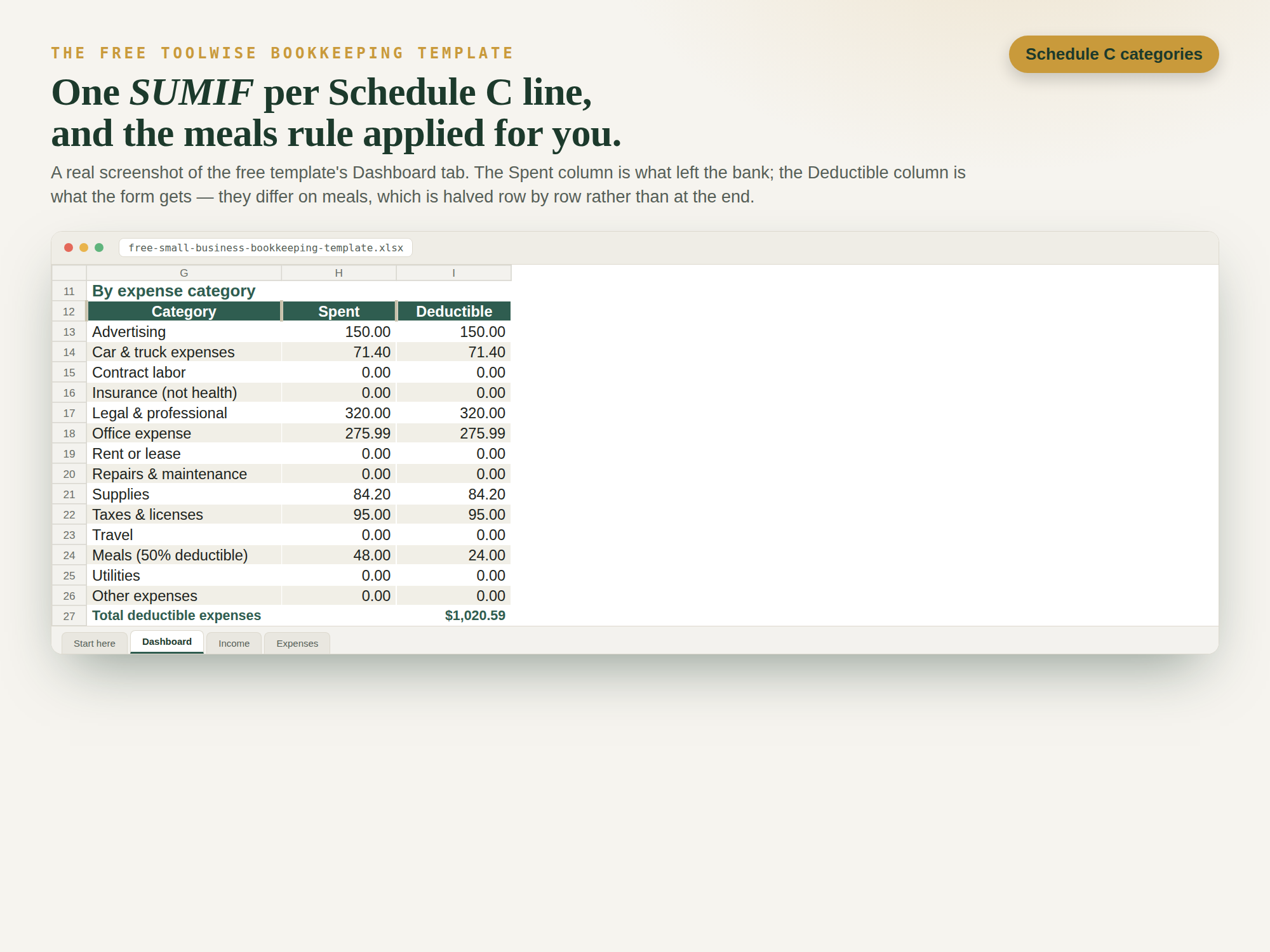
Line 24b is labelled "Deductible meals" for a reason — the amount you enter is not the amount you spent. Halve each qualifying meal as you log it, in its own column, and your running deductible total is right all year. Halve it once at the end and you will forget which entries you already adjusted.
Home office: line 30, not Part II
The test is strict: the space must be used regularly and exclusively for the business, and your home must be your principal place of business. The kitchen table you also eat at fails. Two methods exist — actual expenses apportioned by area (Form 8829), or the simplified option at $5 per square foot up to 300 square feet, a maximum of $1,500 a year (IRS). Keep it out of your ordinary expense categories; the form does.
Equipment versus supplies
The dividing question is whether the thing gets used up. Sandpaper, blades, caulk and packaging are supplies (line 22). A saw, a van, a camera or a laptop is equipment (line 13), where depreciation or a section 179 election decides how much of it you claim this year. It is the single most common miscategorisation in a solo ledger, and the one most likely to be noticed.
Mistakes that cost real money
- Inventing categories the form does not have. A "Software" bucket feels tidy until your accountant has to re-sort it into line 27b. Name it what the form names it.
- Free-typing the category. "Supplies" and "Suplies" split a total silently and neither number is wrong enough to notice. Use a dropdown.
- One "Miscellaneous" bucket that grows all year. Line 27b is itemised in Part V, so an undifferentiated pile has to be broken apart eventually — by you, in April, from memory.
- Recording the meal at full price. Your deductible total is then overstated every month until someone catches it.
- Claiming 100% of a phone that is obviously also personal. Claim the share, and write down how you worked it out.
- Categorising in April. You know what a $71.40 card charge was for today. In seven months it is a mystery, and mysteries end up in Miscellaneous or get dropped entirely.
- Mixing personal and business accounts. Every entry then needs a judgement call before it needs a category.
Rules that keep categories clean
- Use the fourteen you actually touch. Start from the Schedule C list, delete the lines that will never have a number in them, and stop there.
- Category as a dropdown, Schedule C line as a second column. The line number makes the hand-off to an accountant a copy-paste.
- A separate deductible column. Spent and deductible are different numbers, and only one of them belongs on the form.
- Log the date with everything. Mid-year rate changes, quarterly estimates and month-end totals all depend on it.
Categories are not bureaucracy — they are the difference between "I spent a lot on the truck" and "vehicle costs are 15.3% of what I spend, and climbing."
What clean categories actually buy you
Once spending is sorted onto the form's own lines, one =SUMIF(Category,"Supplies",Amount)
per bucket shows where the money goes, your profit figure is real rather than a guess, and tax prep collapses
from a dreaded weekend into an export. It also makes the next question answerable: you cannot
estimate quarterly taxes or work out
how much to set aside until you know your real
profit, and you cannot know your real profit until the expenses are categorised. Everything downstream waits
on this one habit.
Related: how to track business expenses for taxes · self-employed deductions checklist · mileage log for taxes · profit and loss statement · free bookkeeping template
Part of our system for running small business finances in Google Sheets.
Quick FAQ
What are the small business expense categories on Schedule C?
Advertising (8), car and truck (9), commissions and fees (10), contract labor (11), depletion (12), depreciation and section 179 (13), employee benefit programs (14), insurance other than health (15), interest — mortgage (16a) and other (16b), legal and professional services (17), office expense (18), pension and profit-sharing (19), rent or lease of vehicles and equipment (20a) and other business property (20b), repairs and maintenance (21), supplies (22), taxes and licenses (23), travel (24a), deductible meals (24b), utilities (25), wages (26), the energy efficient buildings deduction (27a) and other expenses (27b). Business use of your home is line 30, entered separately.
How many expense categories should a small business use?
About fourteen. Schedule C has 24 expense boxes, but five of them (depletion, employee benefits, pension plans, wages, the energy-efficiency deduction) are empty for a business with no employees. Delete those and you are left with the list a solo business actually fills in — enough to be useful, few enough that you keep doing it.
Which Schedule C line does software go on?
There is no software line. Subscriptions go on line 27b, "Other expenses", and are itemised in Part V of the form. That surprises people because software is often their largest recurring cost.
Do my categories have to match Schedule C?
Not strictly. But the effort of sorting is identical either way, and matching turns filing into a copy-paste instead of a translation. There is no upside to a private category scheme.
What is the mileage rate for 2026?
The IRS set two business rates for 2026: 72.5¢ a mile for 1 January to 30 June, and 76¢ for 1 July to 31 December. For 2025 it was a flat 70¢. Because the rate changes mid-year, a single year-end multiplication gives the wrong answer — log dates with your miles.
Is a $1,000 deduction worth $1,000?
No. It reduces the profit you are taxed on, so it saves tax at your marginal rate plus roughly 14.1% self-employment tax on that profit — often somewhere around $300–$400 on a solo return. Still worth logging, and it is why the small entries matter: they are the easiest to lose and collectively a large share of the total.
What can I not put in any category?
Commuting between home and your regular workplace, personal spending, ordinary clothing you could wear outside work, and education that qualifies you for a new trade rather than improving the one you are in.
Line numbers and labels are from the 2025 revision of Schedule C (Form 1040). This is an organisational guide, not tax advice — rules and rates change, and your accountant has the final word on your situation.